
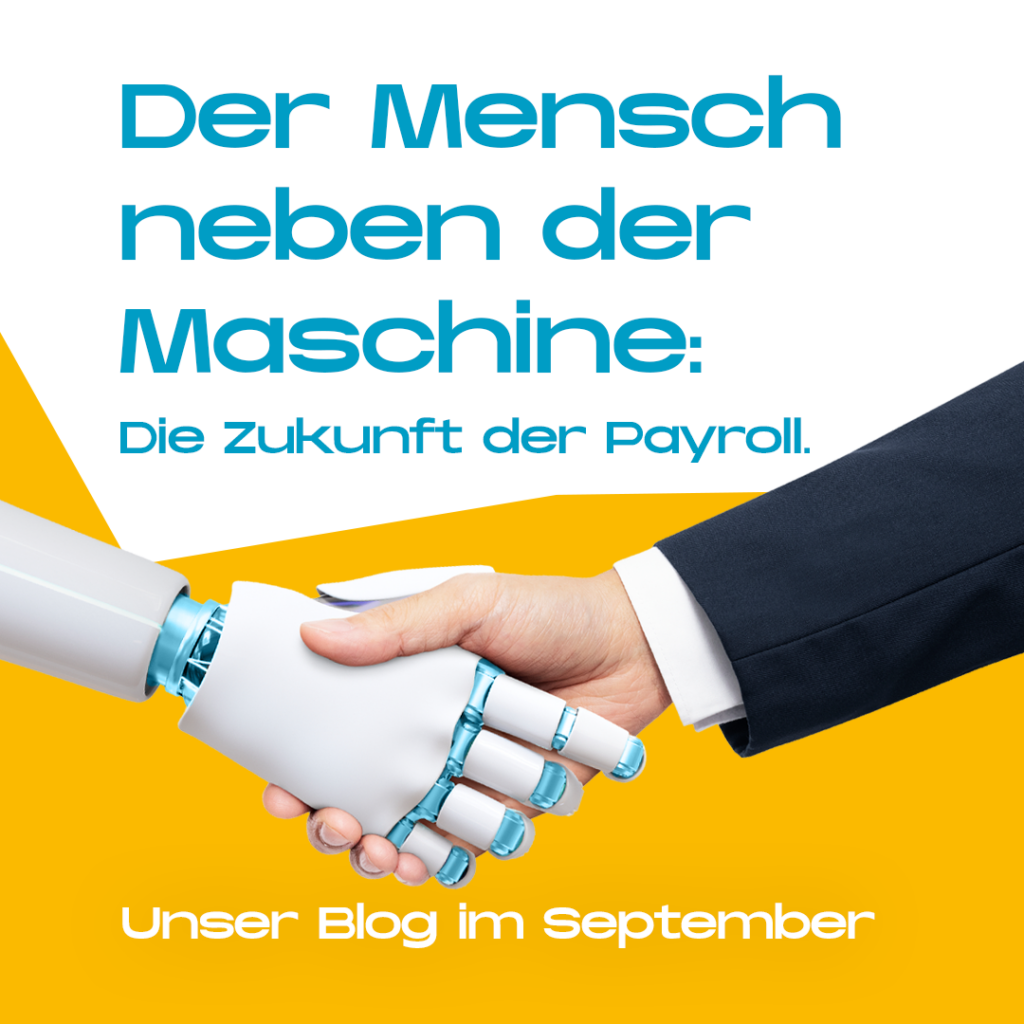
Artificial intelligence and automation are transforming payroll processing. But the payroll of the future will still need people—as points of contact, decision-makers, and those in charge.
The world of work is changing. Artificial intelligence, automation, and digital processes are increasingly finding their way into companies and are also changing the way payroll and compensation are managed.
Master data is processed automatically, workflows are managed digitally, and standard inquiries can already be answered by intelligent systems.
Yet despite all technological advancements, one crucial insight remains:
The future of payroll is no less human. It will become more human.
After all, technology can take over processes. Responsibility remains with people.
Payroll in Transition: Between the Skilled Labor Shortage and Digitalization
The demands on modern payroll departments are increasing.
• The shortage of skilled workers, increasingly complex regulatory requirements, and rising employee expectations are being addressed through the potential of AI and automation.
• Companies are thus faced with the challenge of setting up their payroll systems in an efficient and future-proof manner without losing sight of personalized service.
A modern payroll system must therefore combine various requirements:
• Efficient and secure processes
• digital systems
• automated processes
• Up-to-date expertise
• personalized consultation
• reliable service
The key question here is not whether technology will replace people. The key question is:How can people and technology combine their respective strengths?
What Can AI and Automation Do for Payroll?
Digital technologies are particularly effective at handling repetitive and standardized tasks.
Modern payroll systems, for example, can help with,
• Manage master data automatically,
• Map workflows digitally,
• To support plausibility checks and verification processes,
• Provide self-service options for employees,
• Process standard inquiries more quickly,
• to automate recurring processes.
This offers clear advantages.
Processes are becoming faster, more scalable, and more efficient.
At the same time, this creates opportunities for tasks in which human experience and personal communication are crucial.
Because that is exactly where the second aspect of a sustainable payroll system begins.
What people can accomplish in payroll…
Payroll processing isn’t just about numbers, data, and legal requirements.
Behind every bill is a person. And sometimes a case just isn’t a standard one.
What happens when there’s a specific question? When the situation is complex? When there’s a change within the company? Or when employees can’t easily resolve an issue using self-service?
Then it takes more than just an automated process.
It takes experience, expertise, understanding, and a sense of responsibility.
People can assess individual situations, understand relationships, resolve complex issues, and take responsibility for their decisions. They can listen, explain, and support others through change.
That is exactly why people remain a central part of modern payroll.
People AND Machines: This Is What Payroll of the Future Looks Like
The future of payroll processing isn’t an either/or situation.
It’s not about humans versus machines.
This is about:
Man AND Machine.
Technology takes over routine tasks and boosts efficiency.
People take responsibility, solve complex cases, and provide personalized service.
Or, to put it another way:
Technology is taking over the work.
People take responsibility.
This kind of collaboration can make payroll not only more efficient, but also more personalized.
Digitizing payroll requires more than just new software
Digital payroll isn’t created simply by implementing new software or an AI tool.
The key lies in the interplay between processes, systems, knowledge, and people.
Companies must therefore ask themselves:
• Which processes can be automated?
• Where can AI provide meaningful support?
• Which tasks still require in-person support?
• Are the existing systems future-proof?
• Do employees have the necessary expertise?
• How can we maintain personalized service despite increasing digitalization?
The digitization of payroll processing should not be viewed as an end in itself.
Your goal must be to lighten people’s workload, improve processes, and position companies for the future.
Is Your Payroll System Ready for the Future?
A modern payroll system requires more than just efficient software.
She needs a clear strategy.
These include:
✓ Processes
Structures must be efficient and transparent.
✓ Systems
Digital solutions must be reliable, secure, and scalable.
✓ AI & Automation
Routine tasks can be automated wherever it makes sense to do so.
✓ Knowledge
Technical expertise remains indispensable even in an increasingly digital payroll environment.
✓ Service
Employees and companies need points of contact who can help them with individual questions as well.
Our Philosophy: Technology for People
At ICS adminservice, we don’t believe in payroll without people.
We believe in people who are empowered by technology.
Digital processes that make employees’ jobs easier.
Automation that creates freedom.
And to personal contacts who take responsibility when individualized solutions are needed.
After all, for us, payroll services are more than just the accurate and timely processing of salaries.
They are a combination of payroll processing, consulting, digitization, transformation, and personalized service.
More Than Just Payroll
Payroll in the future will become more digital. It will become more automated. And AI will open up new possibilities.
But she doesn’t become any less human.
On the contrary:
When machines take over routine tasks, there is more time for what people do best— listening, understanding, advising, making decisions, and taking responsibility.
That is precisely where the opportunity for modern payroll lies.
Not human OR machine.
Rather, man AND machine.
After all, the crucial question is not whether technology will replace humans.
Rather, what people can achieve when technology supports them.